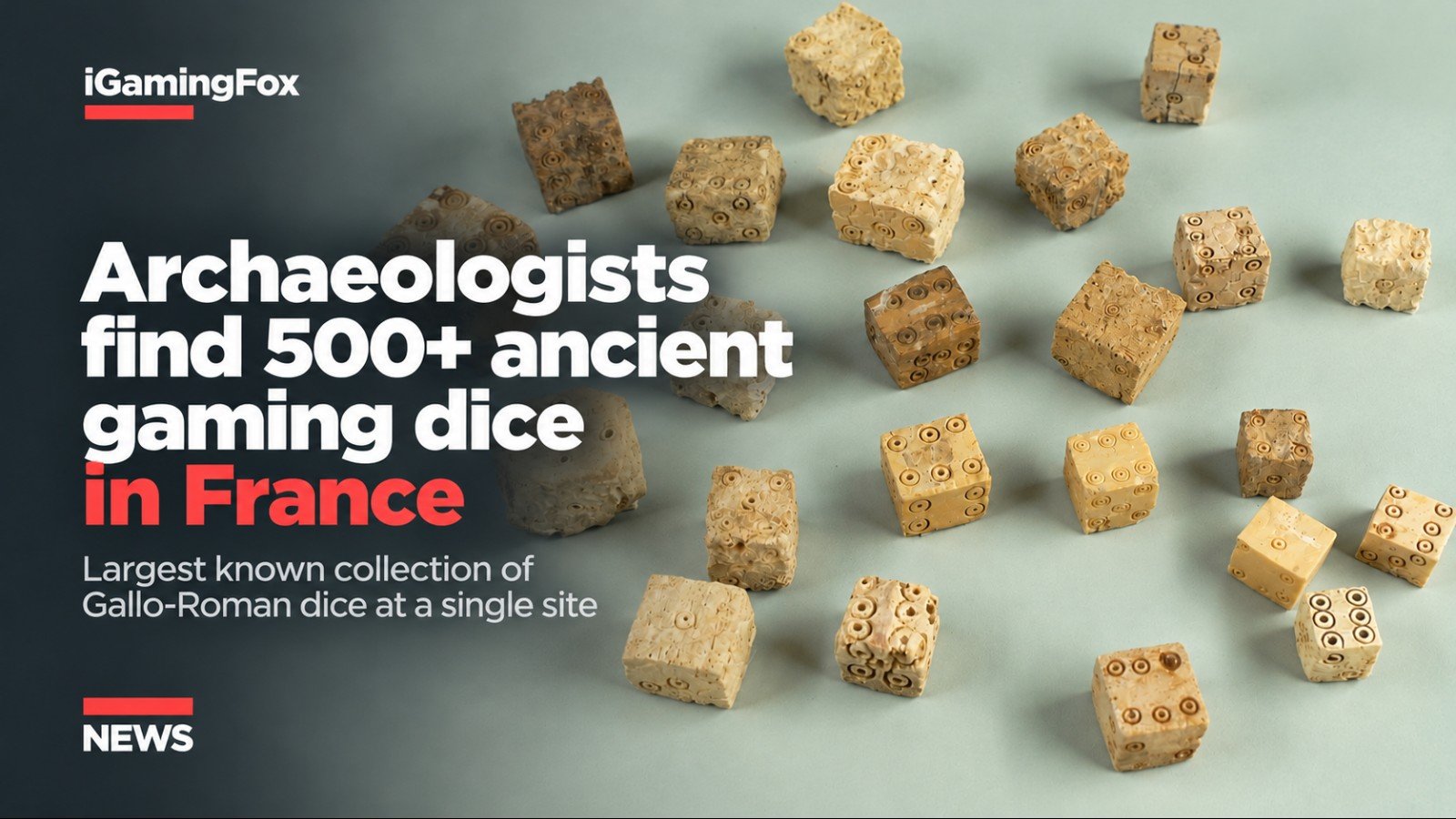
Archaeologists excavating the Gallo-Roman site of Grand in France have uncovered more than 500 ancient dice, potentially the largest known collection of its kind.
Archaeologists in Grand, eastern France, have discovered more than 500 ancient gaming dice at the site of a former Gallo-Roman town, according to the Vosges departmental council.
The objects are believed to date mainly from around the second century AD and represent what researchers describe as the largest known collection of ancient dice discovered at a single site.
Most of the finds are concentrated around a small building whose original purpose has yet to be established.
The unusual density of gaming material has led archaeologists to consider several possibilities, including that the structure was used for games, functioned as a workshop producing dice or had a religious role.
Building May Have Been Connected With Games
One hypothesis is that the building provided a dedicated space for games associated with one of the deities worshipped in ancient Grand.
The settlement was an important religious centre during the Roman period.
Its principal deity was Apollo Grannus, a god associated with healing, but Fortuna, the Roman goddess connected with luck and fortune, was also worshipped there.
The relationship between gaming and religion remains hypothetical, however. Archaeologists have not yet established whether the dice were used for gambling, ritual purposes, manufacturing or a combination of activities.
The concentration of more than 500 examples around the same structure is therefore significant because it may eventually help researchers determine how games fitted into everyday and religious life at the site.
Romans Played Despite Gambling Restrictions
Dice games were widespread across the Roman world.
Playing dice for money was formally restricted under Roman law, with gambling permitted during celebrations such as Saturnalia. Despite those rules, dice remained a popular form of entertainment.
Roman dice broadly resemble their modern equivalents.
On many examples, opposite sides were arranged so that their values added up to seven, a convention that remains standard on most six-sided dice today.
The Grand collection gives archaeologists an unusually large dataset for examining variations in manufacture, numbering and wear.
Archaeologists Are Still Studying the Finds
The excavation has not yet produced a definitive explanation for why so many dice were concentrated in one location.
A workshop would explain the quantity if the objects were being manufactured there, while a gaming venue could account for repeated use and loss. A sanctuary or ritual building remains another possibility given Grand's religious importance.
Further study of the dice, their materials and their archaeological context will be needed before researchers can distinguish between those scenarios.
For gambling history, the discovery offers an unusually large physical record of how deeply dice games were embedded in Roman-era life even when wagering itself was officially restricted.






Kommentit (0)
Ei vielä kommentteja. Ole ensimmäinen!