
Curaçao Sets 24-Hour Deadline for Sanctions Rescreening
CGA guidance requires prompt checks after sanctions list updates, immediate asset freezes on confirmed matches and reporting to the relevant authorities.
This website contains information about gambling and betting and is intended for adults only. You must be at least 18 (or the legal age in your country) to enter.
Gambling can be addictive. Please play responsibly.
Gaming Compliance International estimates unlicensed operators generated €91.6 billion in GGR across the EU in 2025, compared with €36.5 billion for locally licensed businesses.
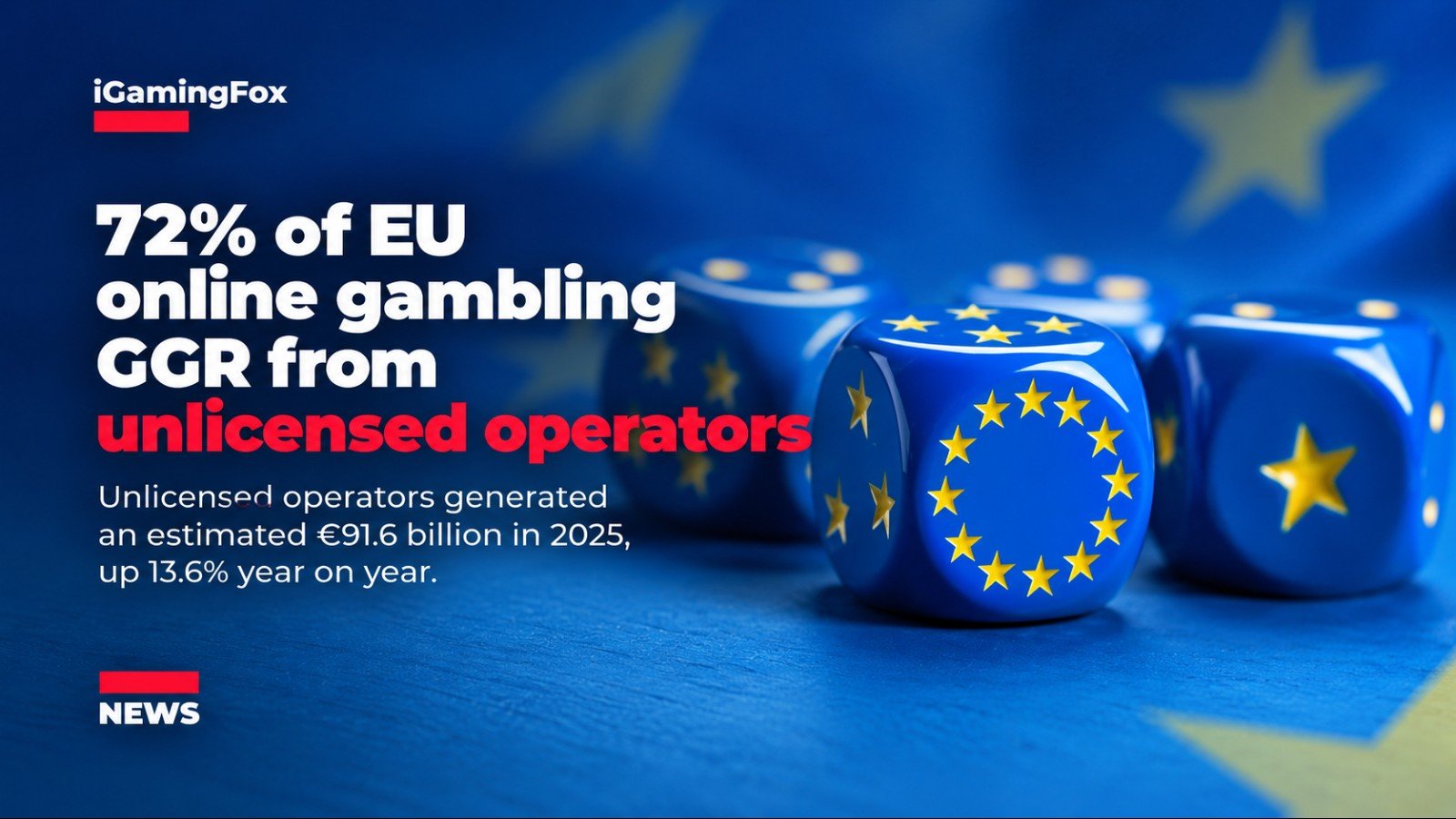
Unlicensed operators accounted for an estimated 72% of online gambling GGR across the European Union in 2025, according to research by Gaming Compliance International commissioned by the Campaign for Fairer Gambling.
GCI valued the combined online sports betting and casino market across the EU's 27 member states at €128 billion in 2025, up 12% year on year.
Of that total, the consultancy estimated €91.6 billion came from operators without a local licence, an increase of 13.6% from 2024 and 74% from 2023. Licensed operators generated €36.5 billion, up 8.6% year on year.
The resulting market shares were 72% for the unlicensed segment and 28% for licensed operators, a one percentage point shift toward the unlicensed market compared with 2024.
The report covers online sports betting and online casino products, including poker and crypto gambling.
Casino accounted for 75% of estimated GGR among unlicensed operators, compared with 59% in the licensed segment.
GCI defines an unlicensed operator as a gambling business that does not hold the required local licence but targets residents of a country and accepts deposits or wagers from them.
The methodology also counts each mirror domain as a separate operator. This means the reported number of operators does not necessarily correspond to the number of distinct corporate groups or gambling brands behind those websites.
GCI said it combined its own monitoring with third-party databases to identify websites and apps accepting bets in each EU country. The report does not disclose the size of the underlying sample.
Based on its estimates, GCI calculated that EU governments potentially missed around €22 billion in GGR-related tax revenue in 2025 because activity took place outside locally licensed markets.
The estimated penetration of unlicensed gambling varied substantially by region.
Eastern Europe recorded the highest share at 81%, representing €30.7 billion in GGR. The proportion decreased by one percentage point from 2024.
Western Europe generated the largest absolute amount of unlicensed GGR at €36.9 billion, equivalent to 74% of its online market and up two percentage points year on year.
Southern Europe reached €17.1 billion, with the unlicensed share rising two points to 60%.
Northern Europe had the lowest estimated penetration at 58%, although that figure increased by three percentage points. Unlicensed GGR in the region reached €6.9 billion.
Growth also differed between regions. GCI estimated unlicensed GGR increased 22.1% in Southern Europe and 21.1% in Northern Europe, compared with 5.9% in Eastern Europe.
Across the EU, growth in unlicensed GGR slowed substantially from 53.2% in 2024 to 13.6% in 2025, but remained above the 8.6% growth recorded by the licensed segment.
GCI also examined how gambling brands reach European consumers.
The report estimates that 121 million people across the EU encountered gambling content online during 2025. Of those, 88 million were exposed to content connected with unlicensed operators.
Among users who actively engaged with gambling-related content, 91% of the material they encountered promoted unlicensed brands. That was one percentage point lower than in 2024.
GCI counted 6,238 unlicensed operators across the EU, up 0.3% year on year, and 17,501 affiliates promoting them, down 15.2%.
The report argues that the size of the unlicensed market cannot be explained only through standalone gambling websites because acquisition increasingly depends on a broader network of affiliates, social platforms, search engines, streaming services, payment providers and apps.
Streaming formed a significant part of GCI's analysis.
Using SimilarWeb data, the report said 19% of Kick's global outbound traffic went to crypto casino Stake during peak periods around the 2026 FIFA World Cup.
GCI also tested Kick across all 27 EU countries and found affiliate promotion for unlicensed gambling operators in 26 of them.
According to the report, Greece was the only one of six countries tested where Kick's officially restricted slots category was actually inaccessible to local users.
Pirated sports streaming represented another acquisition channel. GCI estimated that 95% of European views of illegal World Cup streams carrying sessions of at least 90 seconds included advertising for unlicensed gambling operators.
Those streams generated a reported 17.8 billion views during the tournament.
The report also examined services selling advertising cloaking technology. Providers analysed by GCI claimed average moderation approval rates of around 85%, and more than half of those companies were based in the EU.
The study also compares licensing economics between EU markets and what it describes as transnational jurisdictions, including Anjouan, Curaçao, the Isle of Man and Malta.
Across EU jurisdictions, GCI calculated an average initial licensing cost of approximately €1.1 million for operators covering multiple verticals, compared with around €33,000 in the transnational group.
Average GGR taxation was estimated at 24% in EU markets and 2.3% in the comparison group.
GCI uses those differences to illustrate the financial gap between locally regulated and internationally licensed operating structures.
However, licensing costs, permitted products, compliance obligations and tax structures vary substantially between individual jurisdictions, meaning the averages do not describe every market within either group.
GCI's central conclusion is that the unlicensed market operates through shared international infrastructure rather than isolated websites.
The consultancy argues that country-by-country enforcement is insufficient when operators can rely on payment services, hosting, affiliates, social platforms, search, apps and streaming infrastructure that operate across borders.
Campaign for Fairer Gambling founder Derek Webb said the response should focus on coordinated enforcement between jurisdictions rather than lowering taxes or regulatory requirements for licensed operators.
The report's headline estimates should be read alongside its methodology. GCI counts mirror sites separately, does not disclose the overall monitoring sample size and uses a combination of proprietary monitoring and third-party datasets.
The figures therefore represent GCI's modelled assessment of the EU online gambling market rather than official regulatory totals from all 27 member states.
CGA guidance requires prompt checks after sanctions list updates, immediate asset freezes on confirmed matches and reporting to the relevant authorities.
The former EvenBet Gaming has brought together table games and instant-style titles in a standalone casino offering, including games previously available within its poker client.

January 2026 affiliate expenditure reached a reported monthly record of €7.6 million, although December spending represented a larger share of operators’ gross gaming revenue.
The proposed valuation would exceed Kalshi’s recent $40 billion funding benchmark by $25 billion, while the company has separately ended Donald Trump Jr.’s advisory role.

Breaking iGaming news, bonuses and event alerts — straight to your phone.
Join the channel
Comments (0)
No comments yet. Be the first!